Shell-and-Tube Heat Exchanger: Design, Operating Principle and Uses in Oil & Fat Processing
The shell-and-tube heat exchanger is one of the most widely used types of heat-transfer equipment in industry, thanks to its simple design, reliability, and ability to handle high pressures and temperatures. In oil and fat processing, it is used at almost every stage where a process stream needs to be heated, cooled, or condensed.
Design
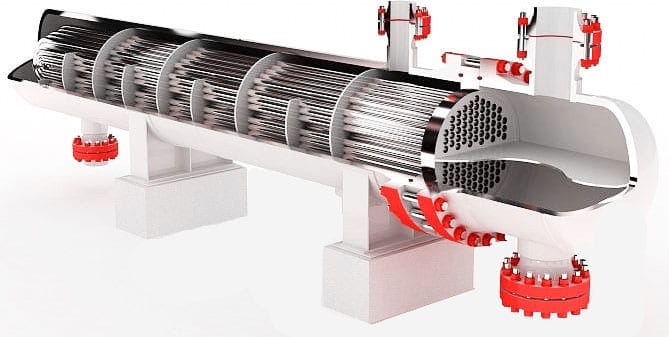
🛢️ Shell — the cylindrical body of the unit, inside which one of the heat-transfer fluids moves (the shell side).
🧵 Tube bundle — a set of parallel tubes carrying the second fluid.
🔲 Tube sheets — fix the tube ends at both ends of the unit and separate the tube side from the shell side, keeping the two fluids from mixing.
➰ Baffles in the shell space — direct the shell-side fluid in a zigzag path between the tubes, increasing turbulence and therefore heat-transfer efficiency, while also supporting the tube bundle and reducing vibration.
🔘 End caps (heads) at both ends — distribute the fluid into the tubes and collect it on the way out; the number of passes through the tube side (single-pass or multi-pass) determines fluid velocity and how compact the unit can be.
Operating principle
Two fluids move on opposite sides of the tube wall — one inside the tubes, the other in the shell space — and exchange heat through the metal tube surface without physically mixing. The most efficient arrangement is countercurrent flow (the fluids move in opposite directions), since it maintains the largest temperature difference along the full length of the unit and therefore delivers the highest heat transfer for a given surface area.
Where it is used in oil and fat processing
🛢️ Cooling finished oil after refining or deodorization — before bottling or storage, oil must be cooled to a safe temperature, and a shell-and-tube cooler using water as the cooling medium is the simplest and cheapest way to do it.
♨️ Preheating miscella before distillation. Miscella leaving the extractor is preheated with steam or hot condensate before hexane evaporation — precise, even preheating directly affects the efficiency of the subsequent distillation.
♻️ Heat recovery. Hot solvent vapor or secondary steam from the distillation column gives up its heat to fresh miscella or another process stream before being finally cooled or condensed — this directly cuts the steam consumption of the whole process.
💨 Condensing hexane vapor. A water-cooled shell-and-tube condenser turns solvent vapor back into liquid for return to the process loop — a key component of any solvent-recovery system.
🔥 Plant heat supply. Inside a boiler room, shell-and-tube heat exchangers prepare hot water or steam at the parameters needed by every section of the plant — from roasters to building heating systems.
The simplicity of its design does not make the shell-and-tube heat exchanger a crude solution — quite the opposite: that same simplicity makes it easy to service (the tube bundle can be pulled out for cleaning or replacement), which matters enormously for equipment that constantly handles viscous, contaminated process streams.
Related area: Industrial Energy.