Why Machine-Tool Precision Directly Determines Finished-Equipment Quality
The quality of industrial equipment is set long before assembly — it is determined by how precisely each individual part is made. If a shaft, housing or bar is machined with a deviation from the drawing, that deviation does not disappear during assembly: it turns into play, uneven wear, vibration or leaks. That is why a shop's machine-tool fleet is not a secondary question of "what to cut metal with" — it is a direct condition for the reliability of the finished product.
D.ENERGY's own machine-tool fleet
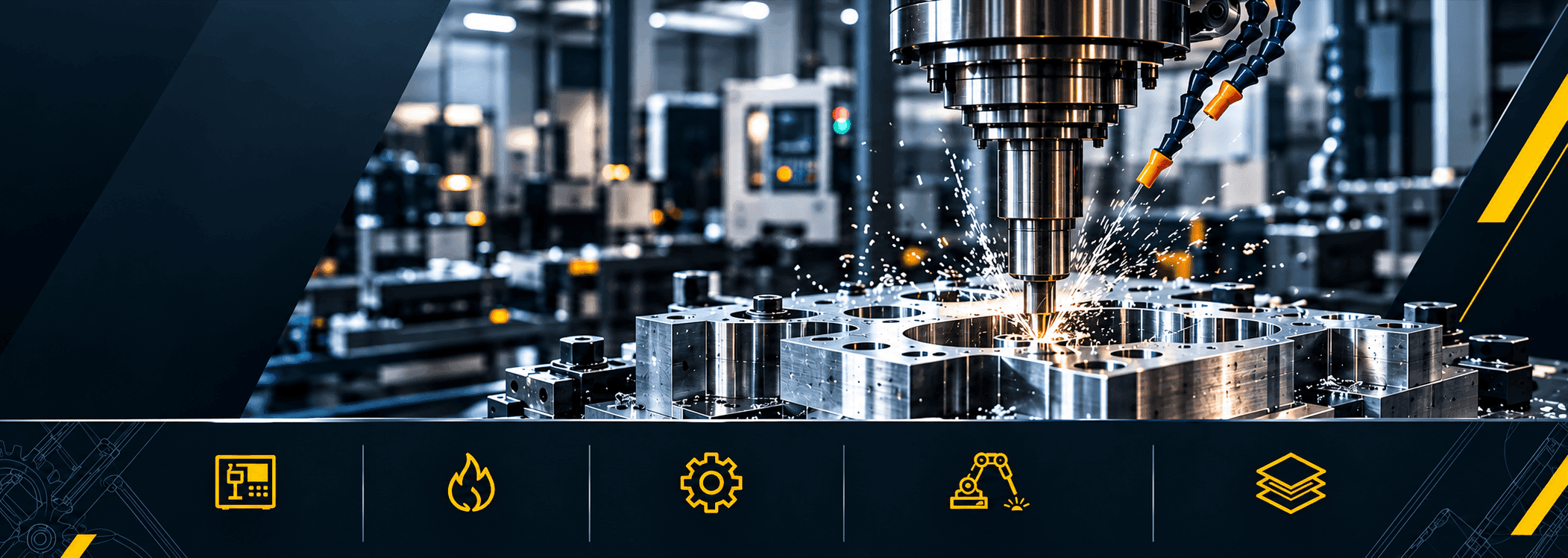
🔩 CNC turning-milling centers (Okuma LB3000, Doosan DM500, Okuma Multus B300) — machine shafts, rods and complex cylindrical geometry in a single setup, without repositioning the part and accumulating error between operations.
📐 Machining centers (horizontal Okuma MA-600H, vertical Okuma Genos M460, Tosvandorf Varia 530) — provide precise milling of housing parts and mating surfaces, which determine how tightly and evenly assemblies come together.
⚙️ CNC vertical (carousel) lathe Toshulin SKQ12 — machining large-diameter parts (flanges, rings, press housing components) while holding tolerances even at large sizes, where error traditionally accumulates fastest.
✂️ CNC band saw KastoWin a3 — precise blank cutting to size, reducing the machining allowance needed afterward and cutting metal waste.
🏁 Surface grinding machines (Geckel GB55, Reinford Ar45, Jung c740 and c740e) — finishing working and mating surfaces to a minimal roughness. This is the stage where, for example, cage bars with a hardfaced working surface are brought to the exact geometry needed for a tight fit inside the press cage.
What this means in practice
When turning, milling, vertical-lathe and grinding operations are all done in-house on a precision machine-tool fleet rather than outsourced without control, every batch of parts repeats the drawing with minimal dimensional spread. For the customer, this means predictable part fit during assembly, even load distribution within an assembly, and, as a result, a longer equipment service life with fewer unplanned repairs.
Related area: Metalworking & CNC Machining.