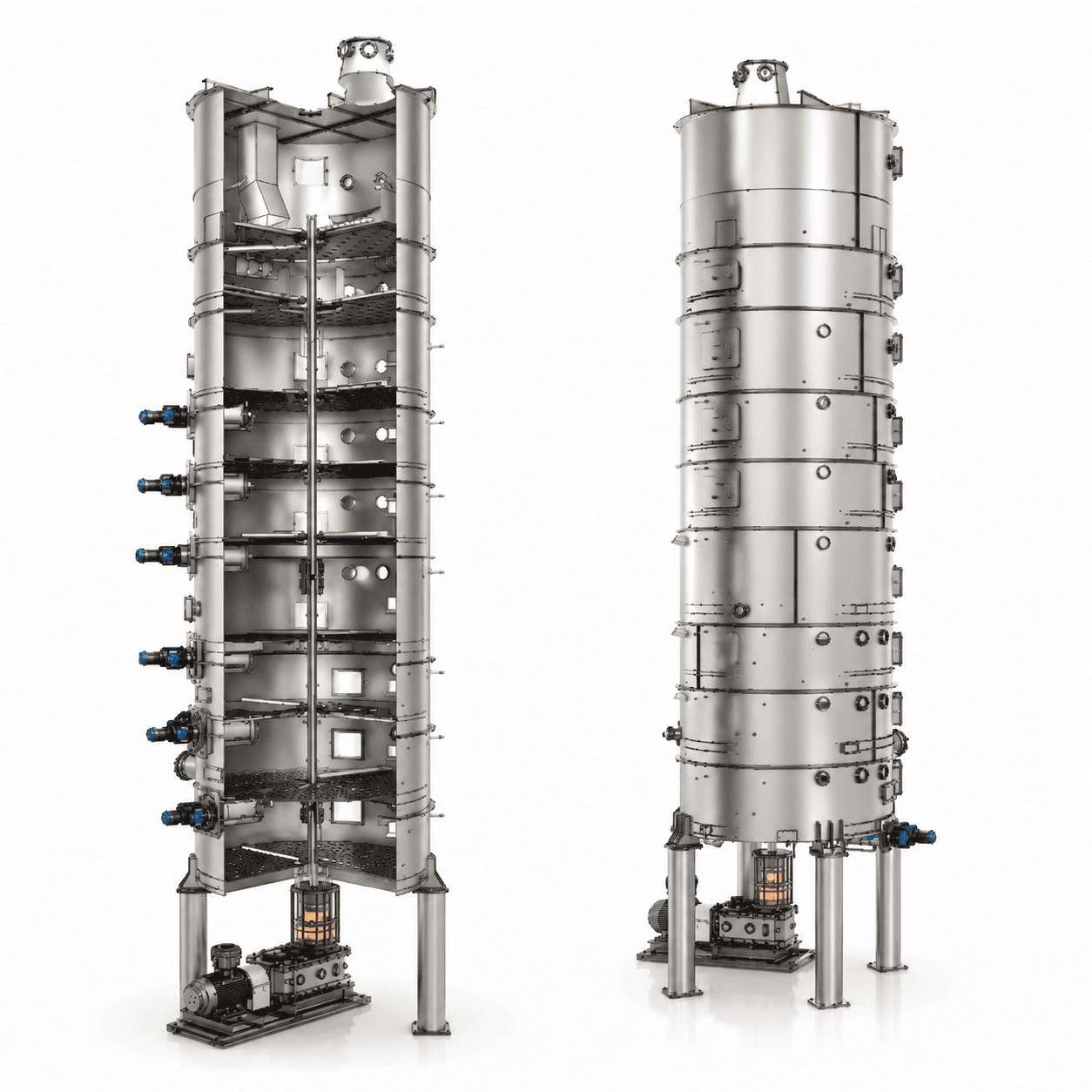
Toasters in Extraction Plants: Types, and Why the DC Series Is a Multi-Tray Design
After the loop extractor, the meal comes out wet and saturated with hexane vapor — it cannot go straight to storage or feed. The unit that brings the meal to its finished state is called a toaster (desolventizer-toaster). This is where the solvent is finally removed from the material, and the meal itself is dried and cooled.
Toaster designs used in the industry
🏗️ Multi-tray (multi-deck) toasters — the meal passes sequentially through several trays (decks) stacked one above another, falling from the upper tray to the one below. Each tray maintains its own heating regime.
🥁 Rotary (drum) toasters — a simpler design with a single rotating drum; lower capital cost, but less precise control of conditions across the whole material volume.
💨 Flash desolventizers — remove solvent with a stream of hot vapor on the fly, mostly used as a pre-stage ahead of the main toaster.
Why D.ENERGY's DC series is a multi-tray design
🎯 A controllable regime on every tray. The upper trays run in steaming / desolventizing mode (removing hexane with direct steam), the lower ones in drying and cooling mode. This is impossible to achieve as precisely in a single shared volume — separating the process into decks is what gives independent control of temperature and residence time at each stage.
⏱️ Stable material residence time. The meal is transferred from tray to tray through adjustable gates, so every batch passes through all stages within a predictable time — no short-circuiting and no unnecessary overheating of protein.
🌡️ Preserved meal quality. Because the heat is distributed across several trays at different temperatures rather than delivered as one powerful pulse, the protein fraction of the meal is subjected to less thermal degradation — which directly affects the feed quality of the finished product.
♻️ Efficient solvent-vapor recovery. The upper trays, closest to the wet-meal inlet, immediately draw off the bulk of the hexane vapor to condensation — safer, and more economical in terms of returning the solvent to the cycle.
In short: a multi-tray design makes it possible to run desolventizing as a sequence of separate, tightly controlled steps rather than one large vessel. That is exactly why D.ENERGY designs its DC-series toasters this way — built around real requirements for meal quality and solvent-handling safety.
Related equipment: DC-series toasters.