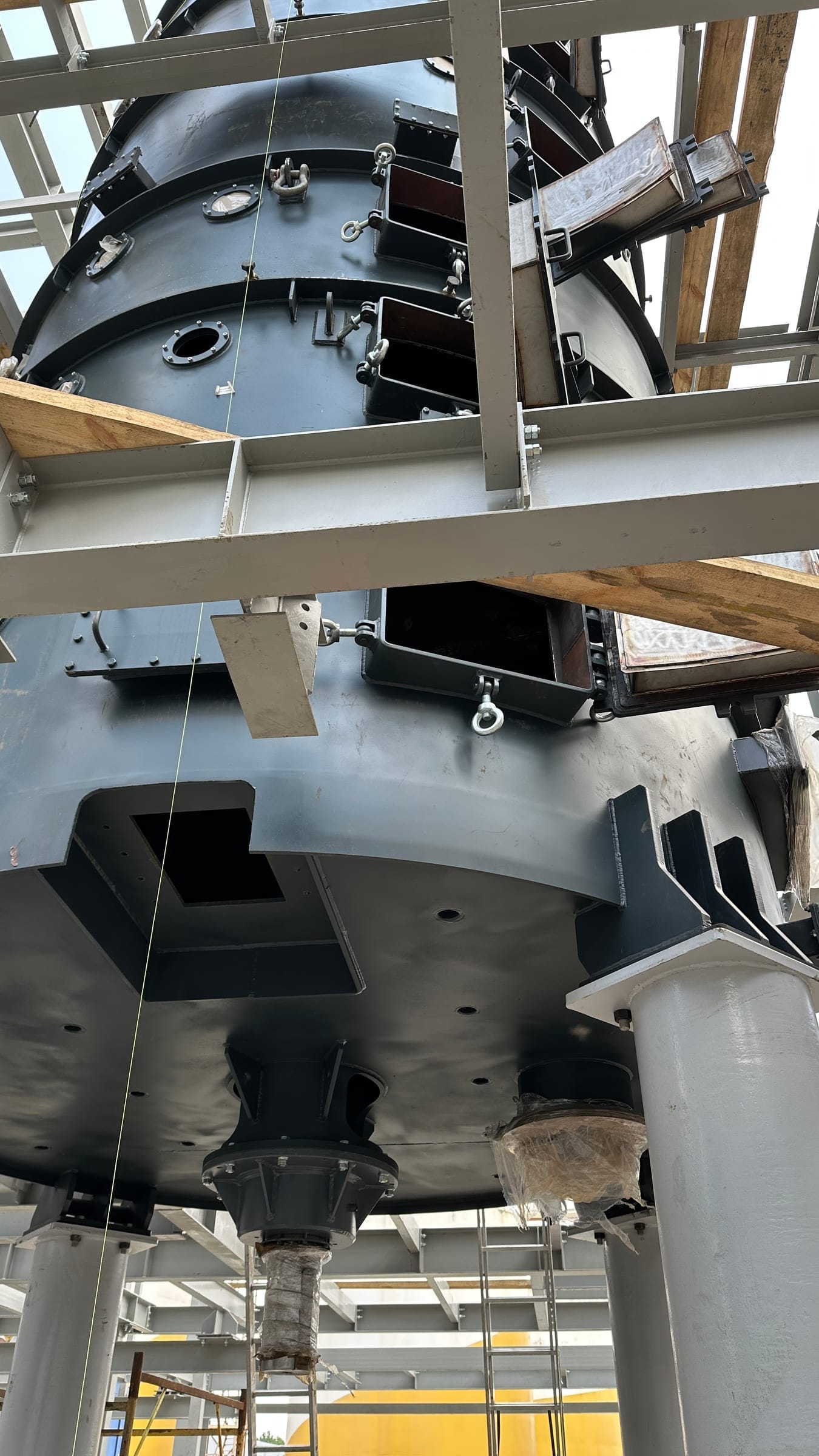
Roasters for Oilseed Processing: Operating Principle and Design
A roaster is a key process unit in an oilseed-processing line (sunflower, rapeseed, soybean, etc.). It performs the moisture-heat treatment of crushed seed (meal/flakes) before pressing or extraction. The oil yield and the quality of the finished product depend directly on how well this unit performs.
How a multi-tray roaster works
A multi-tray (vertical) roaster is the most common solution at oil-extraction plants. It consists of several trays (decks) stacked one above another, each performing its own stage of conditioning.
📥 Feed. Crushed seed flakes enter the top tray of the unit continuously.
🔄 Mixing and transport. A central shaft with paddle mixers rotates inside each tray: it continuously stirs the material, prevents overheating where it contacts the walls, and evenly moves the meal toward the drop opening into the tray below.
🌡️ Heat exchange. The bottom, and often the walls, of each tray have steam jackets — pressurized steam heats the surface and transfers heat into the material.
💧 Moisture control. In the upper trays, the meal is humidified with direct steam to the optimal level — this breaks down the seed's cell structure. In the lower trays, it is instead dried intensively and brought to the target temperature (typically 100–105°C) and moisture content (around 5–7%).
💨 Vapor removal. Moisture released during heating is effectively removed through exhaust ducts of the aspiration system connected to each tray.
Three stages of meal conditioning
1️⃣ Upper trays — conditioning. Heating the material and bringing its moisture to the optimal level with direct steam.
2️⃣ Middle trays — actual roasting. Intensive heating, protein coagulation, breaking the bonds between oil and insoluble matter.
3️⃣ Lower trays — drying and stabilization. Final leveling of temperature and moisture before the material is fed to the oil press.
Advantages of the multi-tray design
♻️ Process continuity — a fully automated cycle from raw-meal feed to finished-meal discharge, with no manual operations between stages.
🎯 High efficiency — passing sequentially through several independently controlled zones allows the target moisture and temperature to be held precisely at every stage.
🌟 Preserved oil quality — even mixing prevents local overheating of the material near the walls, which would otherwise degrade the color and taste of the finished oil.
This is exactly the multi-tray scheme D.ENERGY uses to design its RS-series roasters — sized to the customer's specific line capacity and raw material.
Related equipment: RS-series roasting pans.