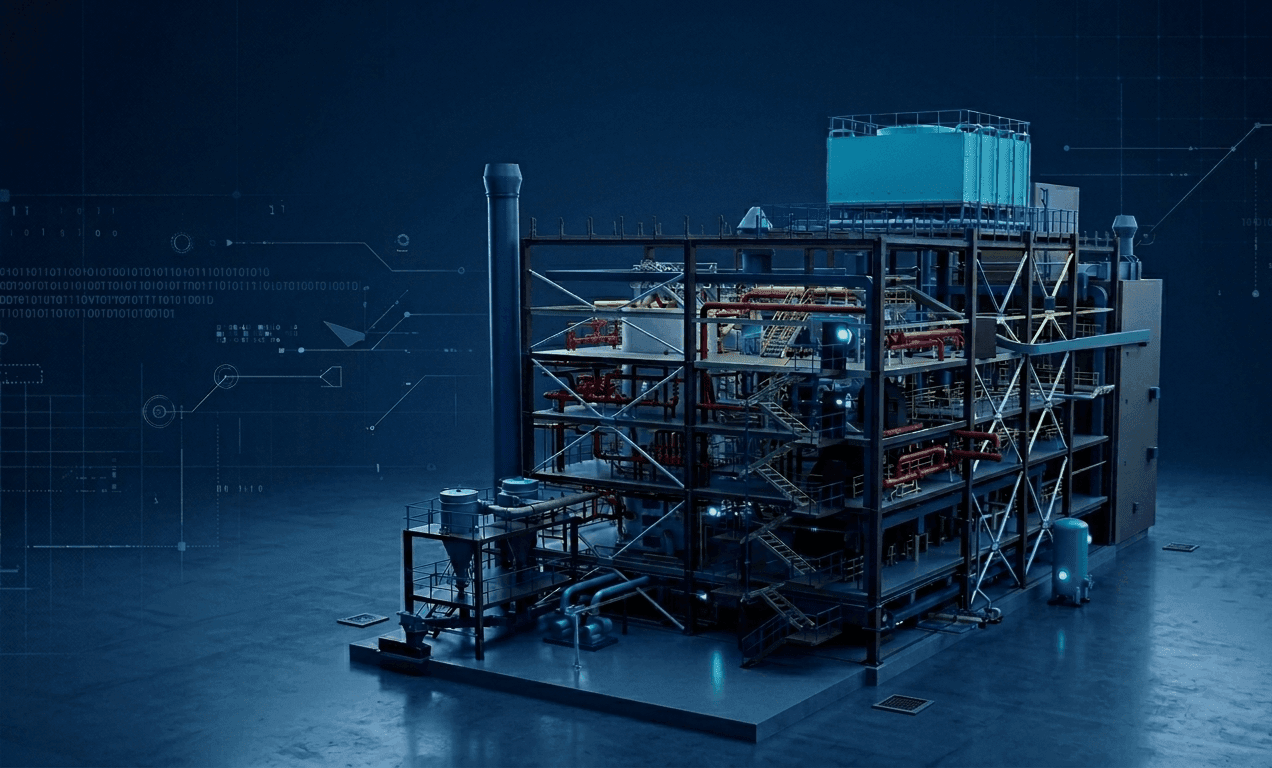
Fundamentals of Oil Mill Design: From Equipment Selection to Process Optimization
Designing an oil mill is not about picking individual machines from a catalog — it is about building a process chain in which the output of every stage matches exactly what the next stage requires as input. A press sized for a different throughput than the roaster feeding it, or an extractor not matched to the distillation station, turns the line into a sequence of bottlenecks — even if every individual machine is well made.
The oil mill process chain
1️⃣ Raw-material preparation. Cleaning, crushing and forming flakes of stable thickness — this is where the quality of every downstream apparatus is set. Flakes that are too thin or too thick equally degrade the results of pressing or extraction that follow.
2️⃣ Thermal treatment (roasting). A multi-tray roaster brings the meal's moisture and temperature to the optimal values (typically 100–105°C, 5–7% moisture) — insufficient conditioning directly reduces the oil yield at pressing.
3️⃣ Oil separation. Mechanical pressing, hexane extraction, or a combination of both — the choice depends on processing volume and the required degree of oil recovery.
4️⃣ Solvent handling (where extraction is used). Miscella goes through filtration, distillation and solvent recovery — a section that requires explosion-proof pumps and shell-and-tube heat exchangers for preheating and condensing vapor.
5️⃣ Finishing the meal. The toaster removes residual solvent and brings the material to the required moisture, after which the cooler brings its temperature down to a level safe for storage.
6️⃣ Line automation. SCADA and HMI tie every stage into a single control picture, while interlocks between units prevent the line from running in unsafe or inefficient modes.
Where optimization actually happens
⚖️ Throughput balance between stages. A line runs only as fast as its slowest unit. Calculating throughput correctly at the design stage is a far cheaper fix than rebuilding an already-installed line.
🛠️ Machining precision. Shafts, housings and mating surfaces machined with deviations from the drawing produce play and uneven wear within just a few months of operation — which is exactly why an in-house precision machine-tool fleet directly affects the reliability of the finished line.
♻️ Wear-part service life. High-wear components (such as press cage bars) should be specified in a wear-resistant design from the start — this reduces how often the line has to stop for scheduled maintenance.
🔥 The energy loop. The boiler room and heat-exchange equipment must be sized for the combined steam load of every unit on the line running at once, not each one in isolation — otherwise steam supply, not mechanics, becomes the production bottleneck.
This is exactly why D.ENERGY designs oil mills as a single system — from the roaster to the automation layer — rather than as a set of individual machines picked on a "good enough" basis.