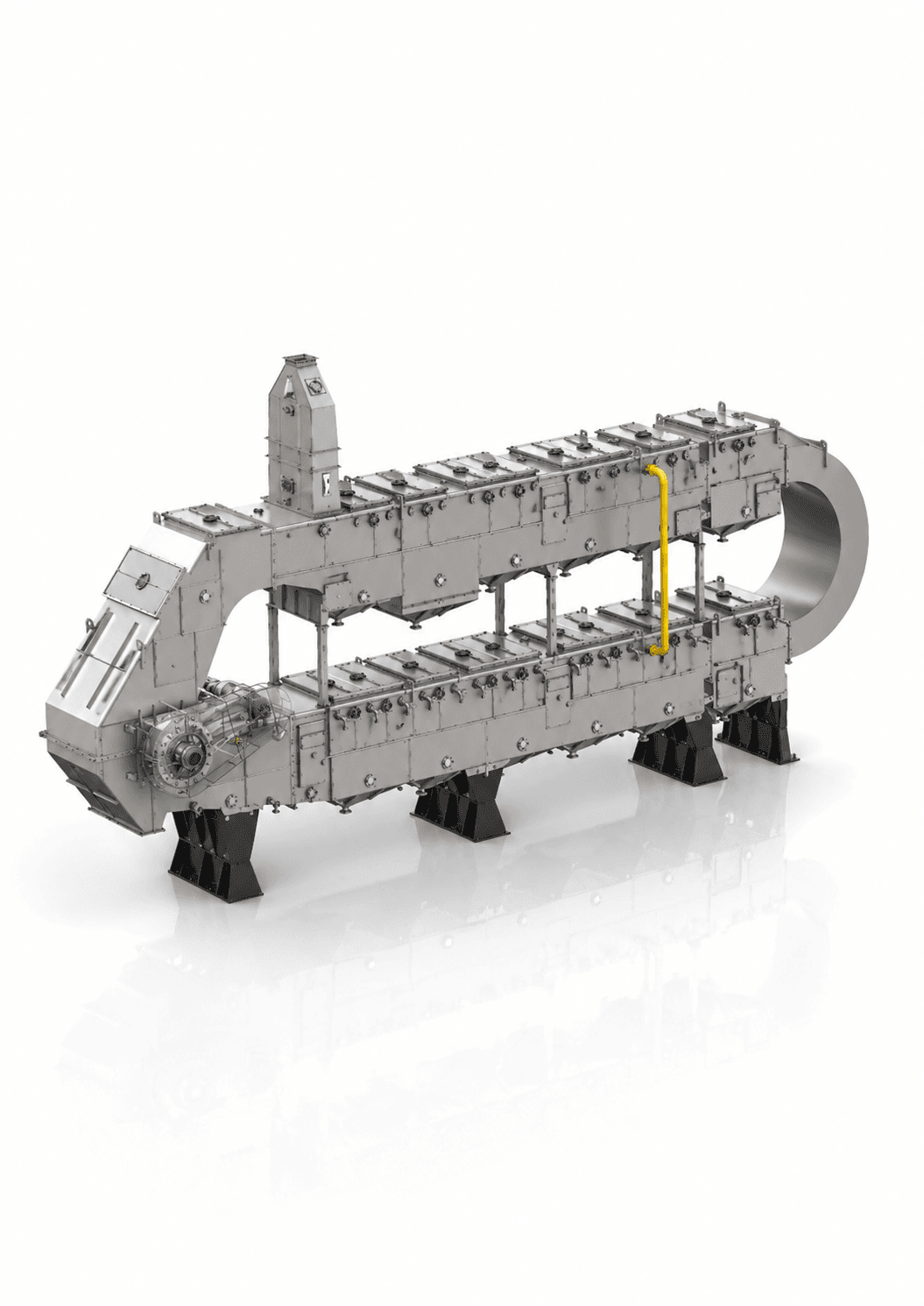
loop extractor
The loop extractor is designed to extract residual oil from seed flakes or cake using an organic solvent (hexane). During the extraction process, miscella (a mixture of oil and solvent) and meal are formed. The equipment works on the “thin layer” principle: the material is continuously moved by a chain conveyor through the upper and lower tiers of a sealed housing, ensuring effective and uniform extraction.
Our Equipment
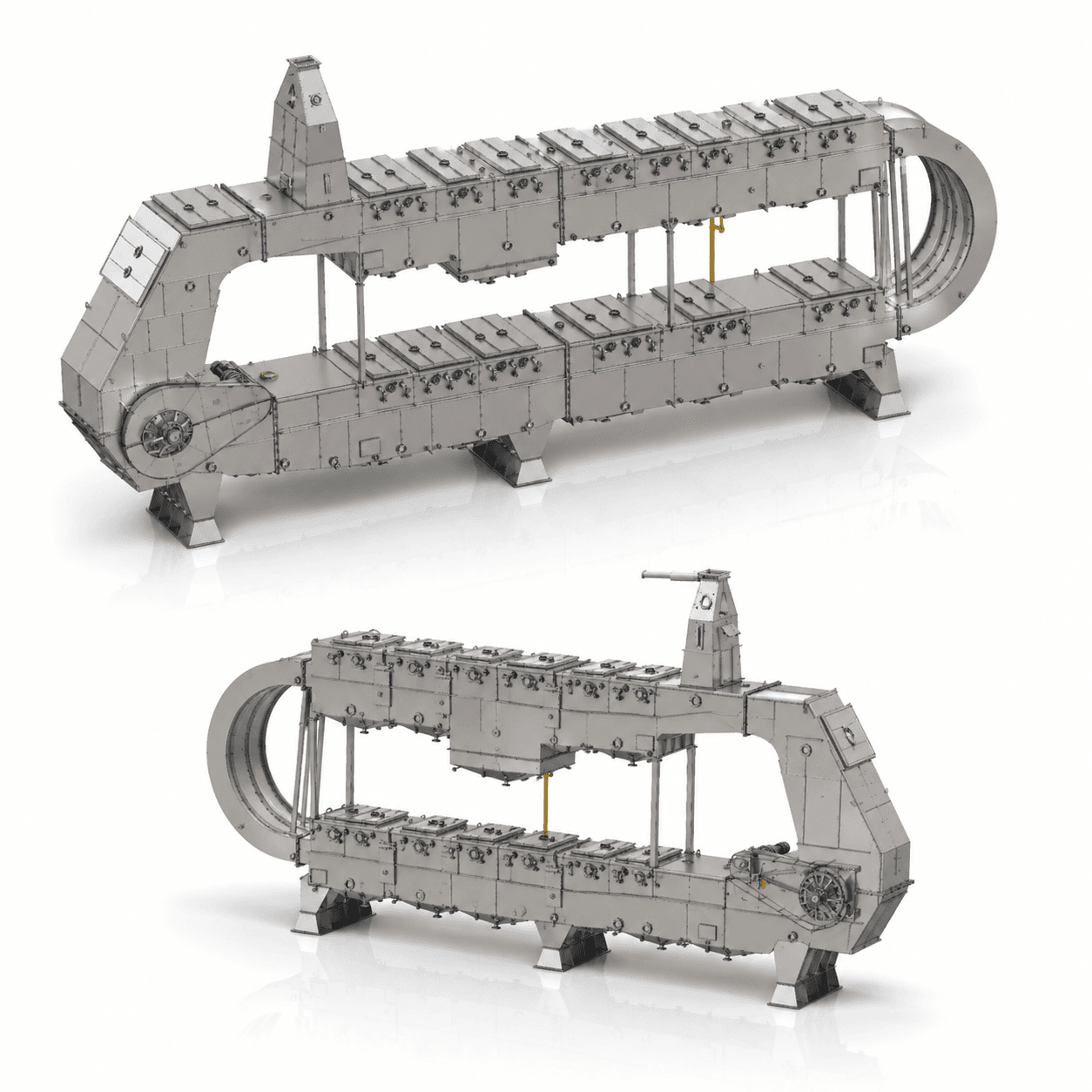
Loop extractor: purpose
A loop extractor recovers residual oil from seed flakes or press cake using an organic solvent, hexane. The process produces miscella (a mixture of oil and solvent) and meal. Extraction brings the residual oil in the meal down to a minimum, which is why large plants build processing as a two-stage scheme: a press first (pre-pressing), then extraction. This recovers the maximum oil from the same amount of raw material.
How a loop extractor works
The machine works on the thin-layer principle: material is moved continuously by a chain conveyor through the upper and lower tiers of a sealed housing. The meal travels in a closed loop against the solvent, which is counter-current extraction. Fresh solvent is fed to the last washing section, where the material is almost fat-free, and as it moves against the feed it becomes enriched with oil and turns into miscella.
Why a loop design
Among the available designs (carousel or rotary, belt and basket extractors) most modern lines choose the loop type:
- Continuous counter-current flow: oil is washed out gradually in several stages rather than in a single pass.
- Gentle material handling: meal lies in an even layer in perforated boxes, so there are fewer fines and better miscella filtration.
- Fewer moving parts: fewer complex sealed rotating assemblies under solvent and simpler maintenance.
- Efficient solvent use: the required recovery with lower hexane consumption per tonne of feed.
- Scalability: from mid-size to large plants without changing the process scheme.
How to choose an extractor
- Capacity. The EX range has 15 models from 20 to 6000 t/day on sunflower seed. For rapeseed and soybean, capacity is confirmed in the project.
- Feed preparation. The extractor cannot correct upstream mistakes: flake thickness 0.25–0.35 mm, minimum fines, temperature 45–55 °C and controlled moisture.
- Residual oil in meal. The key economic indicator, ideally below 0.8–1 %. The solvent-to-feed ratio is kept between 0.8:1 and 1.2:1 depending on the crop.
- Dimensions. Height from 3000 to 16,000 mm, width from 1200 to 6000 mm, length from 5000 to 52,000 mm and internal volume from 20 to 1000 m³.
- Related equipment. The extractor is selected together with the pressing section, toaster, pumps and heat exchangers.
Parameters of all models are on the page of EX series extractors and in the extractors brochure (PDF).
Safety of hexane extraction
Hexane is flammable and its vapour in air is explosive, so extraction equipment is designed as a sealed explosion-safe system: a fully closed loop with no contact between solvent and the plant atmosphere, explosion-proof pumps, ventilation with vapour recovery, gas detectors with emergency shut-off and earthing. More in the article "Hexane extraction or pressing: which gives a higher oil yield and is it safe".
The extractor in the process line
After the extractor, wet meal saturated with hexane vapour goes to a DC series toaster and the miscella goes to distillation using CP explosion-proof pumps. Solvent vapour is condensed and returned to the cycle in shell-and-tube heat exchangers. Regime setup is described in "Optimization and correct regimes at the oil extraction stage" and the reasons for the loop design in "Why a loop extractor is the optimal solution".
Frequently asked questions about extractors
How does a loop extractor differ from a carousel one?
In a loop extractor the meal travels in a closed loop in perforated boxes against the solvent; in a carousel (rotary) extractor it moves in a circle with a rotating section. The loop design has fewer complex sealed rotating assemblies and treats the material more gently.
Is hexane extraction safe?
Yes, provided proper equipment and procedures: a sealed loop, explosion-proof pumps and electrics, ventilation, gas detectors and earthing. These requirements are built into the project from the start.
Which extractor model should I choose?
Choose by daily capacity on raw material, taking into account the crop, flake preparation, room dimensions and related equipment. Send us the input data and D.ENERGY engineers will propose a model and configuration. Contact us.