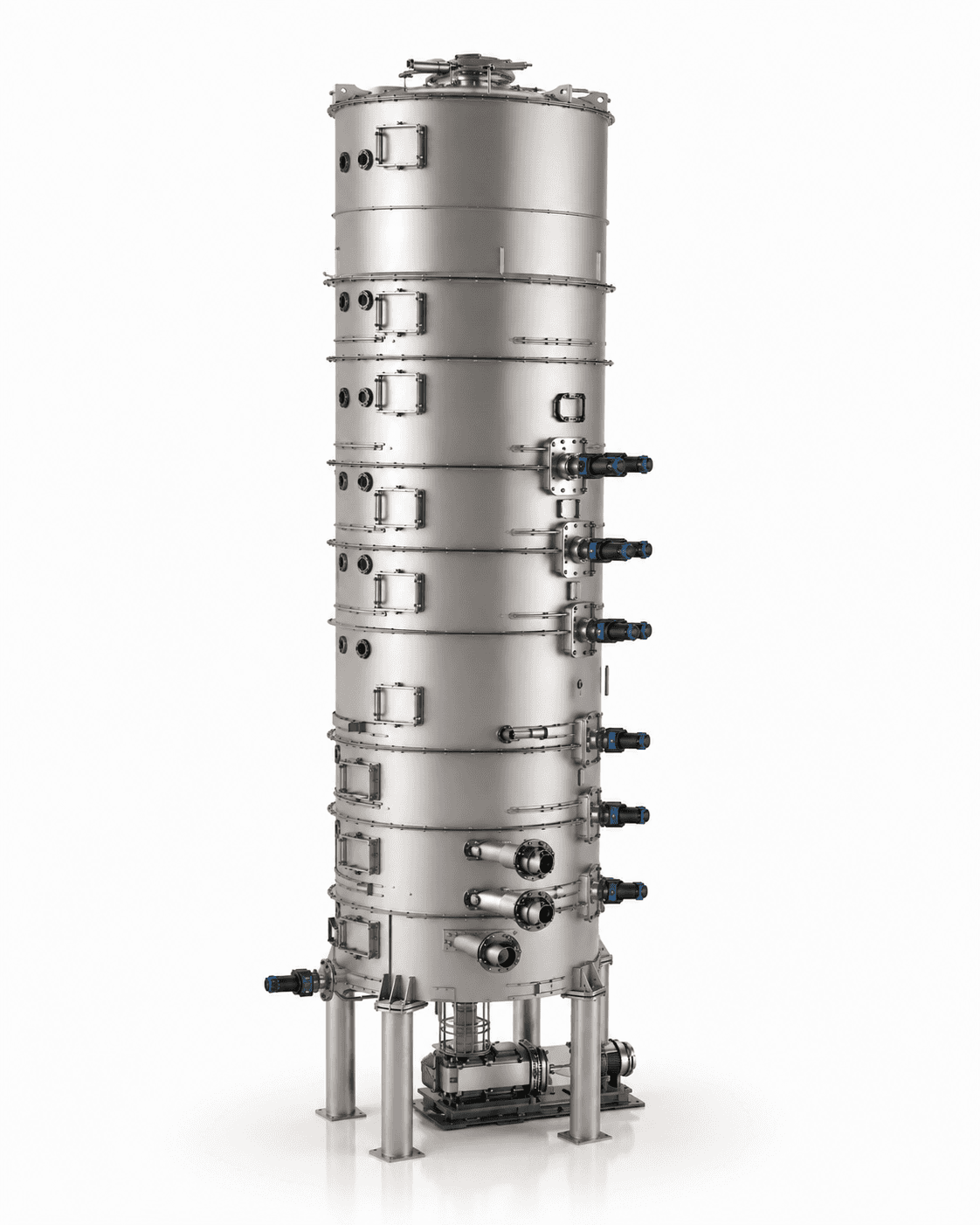
Grain distillation toasters
Toasters are designed to remove solvent residues, dry and cool the meal after extraction. They provide effective heat treatment, maintaining high quality of the finished product. Automated design guarantees continuous, safe and energy-efficient production operation.
Our Equipment
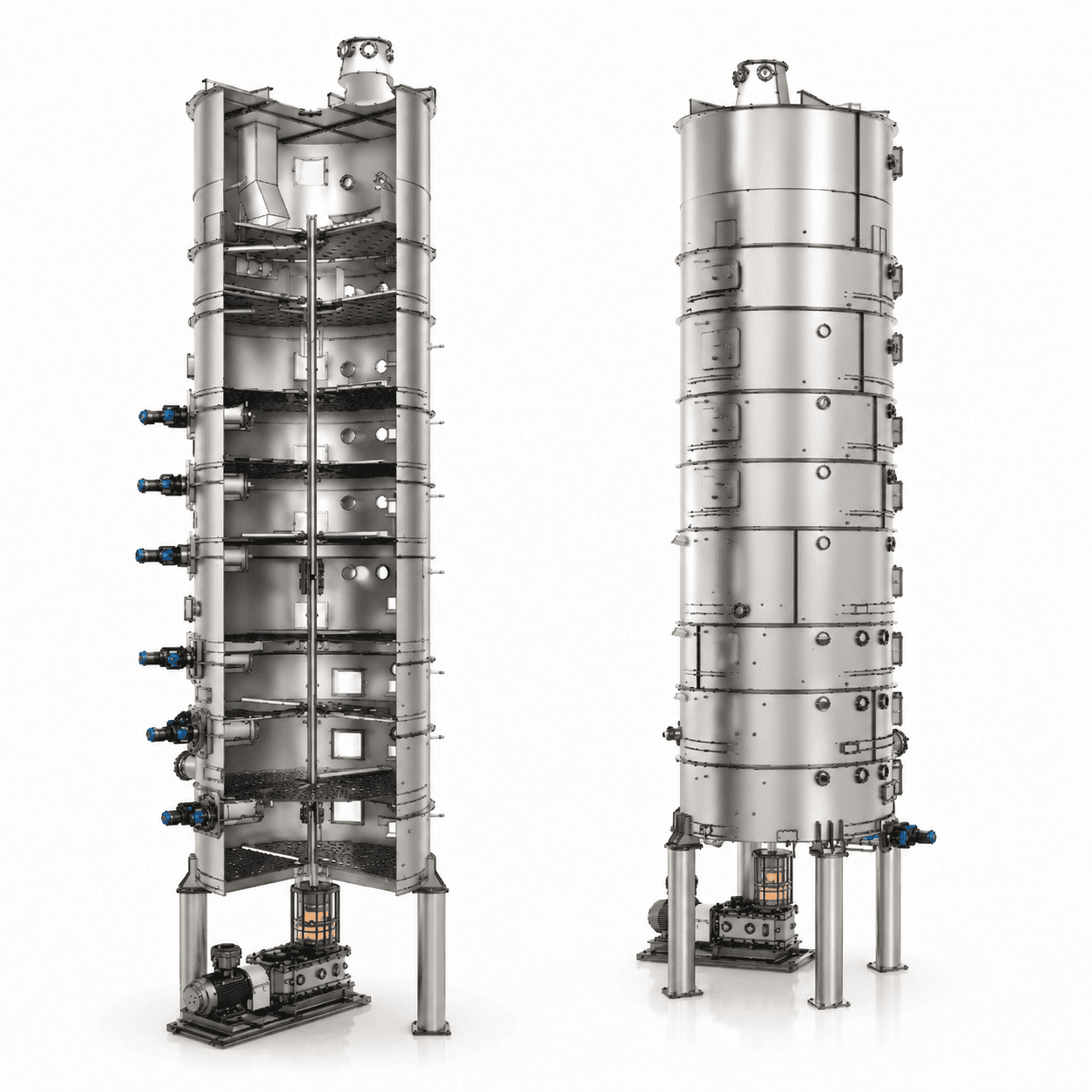
Meal toasters: purpose
After the loop extractor the meal comes out wet and saturated with hexane vapour, so it cannot go straight to storage or feed. The machine that brings meal to its final condition is called a toaster (desolventizer-toaster). Here the solvent is finally removed from the material, and the meal is dried and cooled.
Toaster designs in use
- Multi-vat (multi-tier): meal passes in sequence through several vats stacked one above another, each holding its own heating regime.
- Rotary (drum): a simpler design with a single rotating drum; lower capital cost but less precise control of the regime across the volume of material.
- Flash desolventizers: remove solvent on the fly with a stream of hot steam; mostly used as a pre-stage before the main toaster.
Why the DC series is multi-vat
- Controlled regime on every tier. The upper vats steam and desolventize (hexane removed with live steam); the lower vats dry and cool.
- Stable residence time. Meal moves from vat to vat through adjustable gates, so every batch goes through all stages in a predictable time, with no bypassing and no excess protein overheating.
- Meal quality preserved. Heating is spread over several tiers at different temperatures, so the protein fraction suffers less thermal degradation, which supports feed quality.
- Efficient vapour recovery. The upper vats immediately send most of the hexane vapour to condensation, which is safer and more economical.
How to choose a toaster
- Number of vats. The DC range has 5 to 13. It sets how many separate stages the meal goes through.
- Diameter and column height. Internal diameter is 1500 or 2000 mm and vat column height is 6800 to 16,200 mm. Check them against ceiling height and structural loads.
- Volume. From 12 to 50.9 m³ depending on the model.
- Pressure. Toaster working pressure is 0.098 MPa (0.98 kgf/cm²) and steam chamber pressure is 0.6…1.0 MPa (6…10 kgf/cm²).
- Matching the extractor. The model is selected for the capacity of the loop extractor.
Parameters of all 18 models are on the page of DC series toasters and in the toasters brochure (PDF). Designs are covered in more detail in the article "Toasters in extraction production: types and why the DC series is multi-vat".
The toaster in the process line
The toaster stands at the end of the extraction section. The extractor comes before it, and seed is prepared for extraction on roasters and screw presses. Hexane vapour from the upper vats is condensed and returned to the cycle; the line is controlled by SCADA configured for your plant.
Frequently asked questions about toasters
Why is a toaster needed after the extractor?
Meal after extraction contains solvent and moisture. The toaster removes hexane, then dries and cools the meal so it can be stored and used as feed.
How does a toaster differ from a roaster?
The roaster prepares seed for pressing or extraction, while the toaster works after the extractor and finally removes solvent from the meal.
How many vats should I choose?
The number of vats defines the number of separate stages (steaming, desolventizing, drying, cooling). It is selected for the extractor capacity and meal quality requirements. Contact us.